What Is Graphite Raw Material Used For?
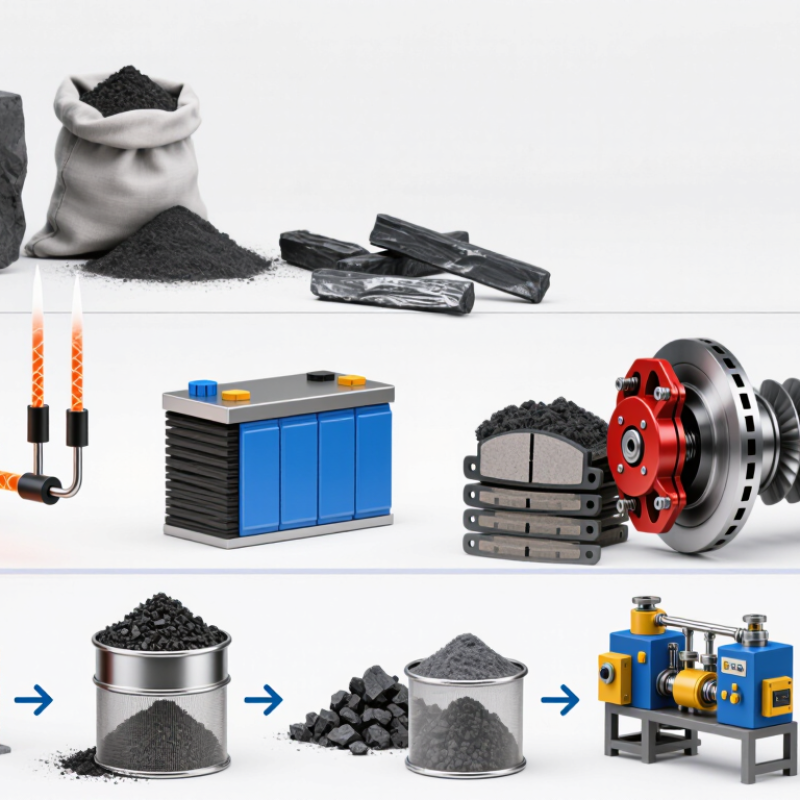
Graphite can look modest in a sack: dark flakes, fine powder, or a dense molded block. Its value becomes clearer when heat, friction, or electrical current enters the picture. Graphite Raw Material serves many industries because it combines conductivity, heat resistance, and natural lubricity. The exact performance depends on its grade, purity, particle size, and processing.
“Graphite is the new oil,” says Simon Moores, chief executive of Benchmark Mineral Intelligence. The phrase points to graphite’s growing role in energy storage, though it is not the whole story. Graphite also goes into steelmaking electrodes, refractory linings, brake materials, and industrial lubricants. In a lithium-ion battery, graphite commonly forms the anode, where lithium ions are stored during charging. In a steel furnace, graphite electrodes carry current and face intense heat. Different jobs. Different specifications.
This guide looks at what graphite raw material is used for, and why buyers compare natural and synthetic grades. It also considers how purity and particle structure affect real-world performance. A bag labeled “graphite” does not tell the full story. That is easy to overlook. Sourcing, processing, and quality checks matter, too. Even so, one trade-off deserves attention: a material suited to one application may perform poorly in another. Knowing the end use is a practical starting point.
Graphite Raw Material: Forms, Grades, and Key Properties
What Is Graphite Raw Material Used For?
Graphite Raw Material: Forms, Grades, and Key Properties
Graphite raw material comes in natural flake, amorphous, and vein forms, as well as synthetic grades. Each suits different processing needs. Flake graphite is often selected for battery anodes and expandable products, while fine amorphous material is used in refractories and friction products. Synthetic graphite is valued where consistent purity and electrical performance matter. USGS Mineral Commodity Summaries 2025 estimates global natural graphite mine production at 1.6 million metric tons in 2024. That figure covers mined natural graphite, not synthetic output.
Grades are commonly described by carbon content, ash level, particle size, and flake dimensions. These details affect conductivity, heat resistance, lubricity, and chemical stability. A larger flake may suit some expandable applications; fine particles can support smoother blends. But a grade label alone is not enough. Supplier test methods and processing history can differ, so compare technical data sheets and verify samples under actual operating conditions. Small differences matter.
Tip: Check fixed carbon, moisture, ash, and particle-size distribution before buying. Ask for recent test results, not just a typical specification. A neat grade name can still hide variation.
How Graphite Supports Steelmaking and Foundry Operations
Graphite supports steelmaking in two distinct ways. In electric arc furnaces, graphite electrodes carry current into the furnace, creating intense heat that melts scrap. The electrodes slowly wear, so conductivity, strength, and oxidation resistance matter. World Steel Association’s World Steel in Figures 2024 reports that electric arc furnaces produced about 28.6% of global crude steel in 2023, or roughly 541 million tonnes. That scale makes reliable electrode performance operationally important.
It is not just an electrode material. Foundries add carbon-bearing graphite to molten iron when they need to adjust carbon content. The right addition can help meet a target grade; poor control can leave the melt off specification. Graphite also appears in refractory linings and crucibles, where its heat resistance helps equipment withstand repeated high-temperature cycles. Dust, moisture, and particle size are practical concerns. Small details matter.
The US Geological Survey’s Mineral Commodity Summaries 2025 estimates world natural graphite mine production at about 1.6 million tonnes in 2024. That figure covers many uses, not steelmaking alone, and it does not measure recycled graphite. This distinction is easy to overlook. For buyers and operators, the useful question is not simply how much graphite is available, but whether its purity and form suit a furnace, melt, or lining. Even experienced teams may need trial adjustments when feedstock varies.
What Is Graphite Raw Material Used For?
Typical carbon-content ranges help explain graphite’s role in steelmaking and foundry operations.
Graphite electrodes conduct electricity to create the high-temperature arc in electric arc furnaces. In foundries, graphite and other carbon additions can raise the carbon content of molten iron. Steel and cast-iron ranges vary by grade and standard; the chart shows typical classification ranges, not graphite addition rates.
Graphite in Batteries and Energy Storage
Graphite is a key raw material in many lithium-ion battery anodes. Its layered structure lets lithium ions move between carbon layers during charging. When a battery powers a device, the ions travel back toward the cathode, releasing usable electrical energy. The graphite does not create energy. It helps store and release it.
In an electric vehicle or a stationary energy-storage system, graphite particles are mixed with other materials and applied as a thin coating on a copper foil. Battery makers control particle size, purity, and coating thickness because these details affect capacity, charging speed, and durability. Natural and synthetic graphite can both serve as anode material, though their processing and performance differ. Small changes matter.
Grid-scale batteries use the same basic principle to hold electricity from solar panels or wind turbines for later use. This can help balance supply when sunlight fades or wind slows. Yet graphite is only one part of the system; cell design, temperature control, and battery management also shape performance. The supply chain has environmental costs, too, including mining and energy-intensive processing. That trade-off deserves attention. Graphite supports energy storage, but it is not a complete solution on its own.
What Is Graphite Raw Material Used For? - Graphite in Batteries and Energy Storage
| Application | Graphite Form | Role in the Battery | Useful Fact |
| Electric vehicles | Purified natural graphite, synthetic graphite, or a blend | Anode material in many lithium-ion battery cells; it stores lithium ions during charging and releases them during discharge. | Graphite is commonly used because it combines useful capacity, cycle life, and electrical conductivity. |
| Grid-scale battery storage | Battery-grade natural or synthetic graphite | Provides the negative electrode in lithium-ion cells used to store electricity and return it to the grid when needed. | The graphite functions inside the cell; the complete storage system also includes cells, controls, and power-conversion equipment. |
| Consumer electronics | Processed natural graphite, synthetic graphite, or blends | Acts as the lithium-ion cell anode in devices such as laptops, tablets, and phones. | The anode’s design and processing affect battery performance, alongside the electrolyte, cathode, and cell design. |
| Power tools and backup batteries | Battery-grade graphite, selected for the cell design | Supports lithium storage at the anode in rechargeable cells used for portable power and backup applications. | Cell makers balance energy capacity, charging rate, durability, and safety when choosing anode materials. |
| Lithium-ion anode capacity | Graphite with lithium stored between its carbon layers | The fully lithiated graphite composition is commonly represented as LiC6. | Theoretical specific capacity is about 372 mAh/g; practical electrode performance depends on material and cell design. |
| Sodium-ion energy storage | Typically a different carbon material, such as hard carbon, rather than conventional graphite | Hard carbon is widely used as the anode in many sodium-ion cell designs. | Graphite does not generally store sodium effectively in standard carbonate electrolytes, though specific electrolyte systems can change its behavior. |
Note: In lithium-ion batteries, graphite is generally used in the anode, not the cathode. Battery-grade material requires processing and quality control before use.
Refractory, Lubricant, and Thermal Management Uses
Graphite raw material is used in refractory bricks because its heat resistance and layered structure help furnace linings withstand thermal shock and contact with molten metal. Magnesia-carbon bricks are common in steelmaking vessels. The World Steel Association reported 1.89 billion tonnes of crude steel production in 2023, showing the scale of an industry that depends on durable furnace materials. Graphite grades and brick formulations still matter; performance is not automatic.
Graphite’s slippery layers also make it useful in dry lubricants, especially where oils may break down under heat or attract dust. It is not suitable for every environment: oxidation and contamination can limit performance. For thermal management, processed graphite sheets spread heat across electronics and other compact devices. Their conductivity varies by grade and direction, so a single product figure can mislead. The USGS Mineral Commodity Summaries 2024 estimated global graphite mine production at 1.6 million tonnes in 2023, up from 1.3 million tonnes in 2022. That supply serves multiple uses, not just electronics. The details matter. I would not treat graphite as a universal fix.
Everyday Products Made with Graphite: Pencils and More
What Is Graphite Raw Material Used For?
Everyday Products Made with Graphite: Pencils and More
Graphite is a form of carbon that feels soft and leaves a dark mark. In a pencil, the core is not lead. It is usually graphite mixed with clay and a binder. More clay makes the core harder; more graphite generally creates a darker stroke. That difference matters when sketching, taking notes, or shading a page. The familiar pencil is simple, but its performance depends on a carefully balanced material.
Tips: Test a pencil on scrap paper before drawing. A softer core may smudge, so keep a tissue nearby. Small detail, big difference.
Graphite also appears inside many rechargeable batteries, where it can serve as an anode material. It is used in some electric motor brushes and industrial parts because it conducts electricity and tolerates heat. Formulations vary, so not every battery or component uses graphite in the same way. Its uses can feel distant from the pencil in your hand. Still, both rely on graphite’s useful combination of softness, conductivity, and stability. One thing is easy to overlook: graphite dust can be messy, and finished products are designed differently from loose raw material.