
How to Choose a Solar Water Purification System in 2026
Choosing a Solar Water Purification system in 2026 starts with the water you actually have, not the product brochure. Is the source a clear well, a silty river, or brackish coastal water? Each presents different treatment challenges. Solar heat or sunlight can support purification, but neither automatically removes every contaminant. A system’s performance depends on its design, maintenance, and the quality of its feedwater.
Water-treatment engineer Dr. Ashok Gadgil’s work on practical, low-cost disinfection offers a useful reminder: a technology matters only when people can use it reliably in real conditions. That principle belongs at the center of any buying decision. Ask for independent performance data, clear operating limits, and instructions for testing treated water. Check what happens on cloudy days. Look closely at replacement parts, storage, and cleaning needs. A small filter cartridge can become a serious weak point when it is hard to find.
The right system is not always the most advanced one. It may be the unit that fits your household’s daily demand, local sunlight, and maintenance capacity. Still, solar-powered treatment should not be treated as a universal fix. Some water needs additional filtration or testing. That deserves honest attention. This guide explains how to compare system types, verify claims, estimate real output, and choose a setup that can keep producing safe water beyond the first sunny week.
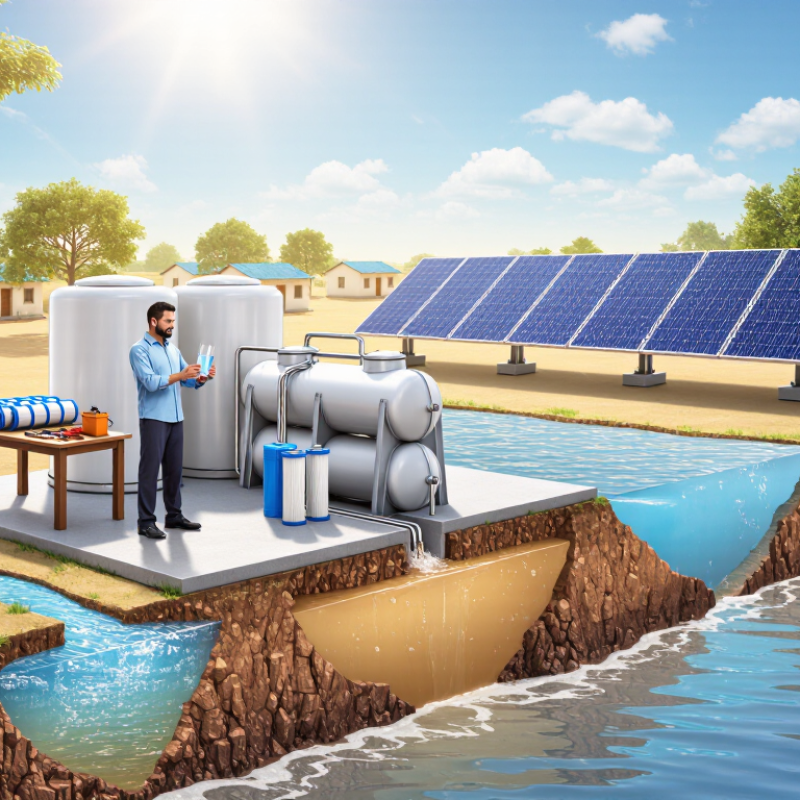
Define Water Needs and Source Conditions
Start with daily demand, not panel size. Count users and estimate drinking, cooking, and basic hygiene needs in liters. Add a realistic reserve for cloudy days and seasonal visitors. WHO and UNICEF’s 2023 Joint Monitoring Programme report estimated that 2.2 billion people lacked safely managed drinking water in 2022. That figure underscores why “clear” water is not a reliable safety test. Request laboratory testing for microbial contamination and relevant local chemicals, such as arsenic or fluoride. Source conditions vary.
Describe the water source in practical terms: a muddy stream after rain, a brackish well, or roof runoff collected in a tank. Note turbidity, salinity, and seasonal changes. WHO’s 2011 household-water-treatment guidance identifies turbidity above 30 NTU as a reason to pretreat water before solar disinfection. Dissolved salts and many chemicals need different treatment; sunlight alone will not remove them. A solar-powered membrane system may suit salty water, while sediment filtration may be needed for visibly cloudy sources. Check expected output against your daily liters and local sunlight, not just peak ratings. Small details matter. I would still leave a margin: real household use rarely follows a tidy worksheet.
Compare Solar Water Purification Technologies
Compare the feed water before comparing equipment. The WHO/UNICEF Joint Monitoring Programme reported that 2.2 billion people lacked safely managed drinking water in 2022. That figure underscores the need for treatment matched to local risks, not just sunshine. Solar stills use heat to evaporate water and condense it on a clean surface. They can remove salts and many microbes, but output falls on cool or cloudy days. They also need frequent cleaning to prevent scale and biofilm.
Photovoltaic-powered reverse osmosis pushes water through a membrane. It suits salty or brackish sources better than simple disinfection, but requires prefiltration, pressure, and membrane maintenance. The World Bank’s 2019 desalination review puts seawater reverse osmosis energy use at roughly 3–4 kWh per cubic meter, before site-specific needs. Solar panels can supply that power, though storage or backup may be necessary when sunlight drops. A practical distinction.
Solar disinfection uses sunlight to inactivate pathogens in clear water, often in small transparent bottles. Eawag’s SODIS guidance recommends about six hours of strong sunlight; cloudy conditions can require longer exposure. It is not desalination. It also does not reliably remove chemical contaminants. In field assessments, I would check turbidity, salinity, daily demand, and who can replace parts. A low-cost unit may still fail if its filter is hard to source. These comparisons are imperfect: feed-water quality and local maintenance can change the result.
Assess System Capacity, Energy Storage, and Reliability
Choose capacity from real daily demand, not the pump’s peak-flow label. The WHO/UNICEF Joint Monitoring Programme reported that 2.2 billion people lacked safely managed drinking water in 2022. For a household system, estimate litres needed for drinking and cooking, then check production under cloudy conditions and with the actual source water. Turbid water can slow treatment. A tidy spreadsheet may still miss that.
Match storage to energy use after accounting for pump start-up, controller losses, and battery limits. Compare usable battery capacity, not just the advertised total. Estimate how many low-sun days the system must cover before choosing autonomy; remote sites may need more reserve than homes with backup power. Keep the battery in a shaded, ventilated enclosure, and confirm that replacement parts are available locally. Small details matter.
Check performance data and maintenance needs before buying. The National Renewable Energy Laboratory’s review of photovoltaic degradation found a median decline of about 0.5% per year across studied systems. That is a useful planning benchmark, not a guarantee for every site. Ask for tested daily output, water-quality verification, filter replacement intervals, and fault protections. Reliability is not only long life. It is also knowing what to do when flow drops at dusk.
Check Water Safety, Certifications, and Maintenance Needs
A solar-powered purifier should be chosen around the water source, not its panel size. Clear water can still contain bacteria, nitrates, arsenic, or dissolved salts. Looks clear. That proves little. Get a laboratory test before shopping, especially for well, river, or rainwater. Ask which contaminants the system reduces and at what flow rate. A general “safe water” claim is not enough.
Check certification documents, not just badges on a product page. Confirm the exact model and treatment claims appear in a current, independent listing. Standards differ: one test may cover microbial reduction, while another addresses chemical contaminants. If your water contains something the system is not certified to remove, consider another treatment stage. Solar power changes the energy supply, not purification performance.
Maintenance is where good plans get inconvenient. Compare replacement-filter intervals, local availability, storage life, and cleaning steps. UV units need reliable power and clean sleeves; membranes can clog when source water is muddy. Keep a dated log of filter changes and test treated water periodically. A spare cartridge sounds sensible, though it may expire on a shelf. Check the instructions against your sunlight, daily water needs, and winter conditions before relying on the system.
Compare Costs and Select a System for Your Setting
Start with a water test and daily demand estimate. A clear stream can still contain microbes, salts, or agricultural chemicals. Solar disinfection or UV treatment may suit low-turbidity water with microbial risks, but neither removes dissolved salts. For brackish water, reverse osmosis may be necessary, with higher energy use and reject water to manage. Match the treatment to the hazard, not the panel size.
Compare full costs, not purchase prices alone. Include panels, pump, purifier, batteries, storage tanks, filter replacements, and technician visits. The IRENA Renewable Power Generation Costs in 2023 report put newly commissioned utility-scale solar PV at a global weighted average of $0.044 per kilowatt-hour. That is a useful energy benchmark, not an off-grid system quote. Small installations can cost more per unit of power. Not just panels.
For a remote clinic, price spare filters and battery replacement alongside the initial equipment. For a seasonal cabin, a direct-solar system with covered water storage may avoid battery costs, if demand can wait for sunlight. Compare each option’s cost per treated liter over its expected service life. WHO and UNICEF’s 2023 Joint Monitoring Programme estimated that 2.2 billion people lacked safely managed drinking water in 2022, underscoring why reliable treatment matters. Get local installation quotes; sunlight, water quality, and maintenance access change the answer. I’d still budget for downtime—many comparisons understate it.