
2026 Top Terrain Cart Types Which One Is Best?
Choosing the best Terrain Cart in 2026 is not simply about power, speed, or appearance. The right choice depends on ground conditions, payload, distance, maintenance access, and operator experience. A cart crossing wet grass needs different support from one climbing gravel paths or carrying tools through woodland. Small details matter. Tire width matters. Ground clearance matters.
This guide examines the leading Terrain Cart types, including electric utility carts, gas-powered models, four-wheel-drive carts, tracked carriers, and compact towable units. Each design offers practical strengths and noticeable limitations. Electric models can move quietly across private property, while gas-powered carts may provide longer working periods between refueling stops. Four-wheel-drive systems improve traction, but they can increase cost and service complexity. Tracked carts spread weight effectively, although steering them may feel less natural at first.
Real-world use often reveals more than a specification sheet. A muddy slope can expose weak tires within minutes. A narrow gate can make a wide cart almost useless. We also consider braking, turning stability, battery endurance, suspension comfort, weather protection, and replacement-part availability. These factors influence reliability over months, not just during a short demonstration.
There is no universal winner. That answer sounds convenient, but it is usually incomplete. The best Terrain Cart matches your property, workload, storage space, and budget. Some recommendations may change after careful testing. Even experienced buyers can underestimate terrain changes throughout the year. Use this comparison to identify the cart type that fits your actual conditions, not an idealized version of them.
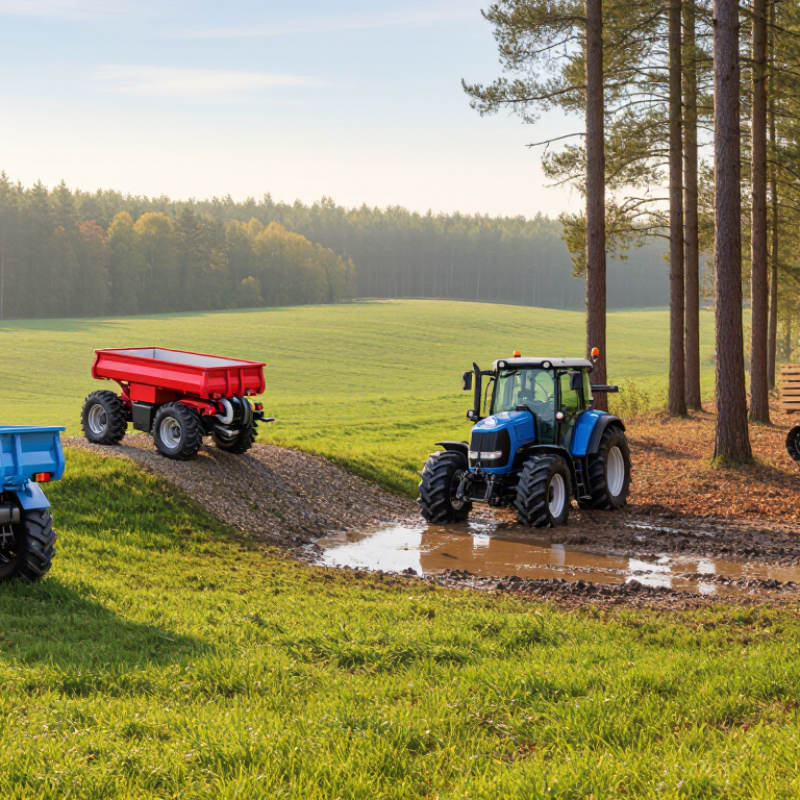
Classify Terrain Carts by 4x2, 4x4, and Tracked Drivetrains
2026 Top Terrain Cart Types: Which One Is Best?
Classify Terrain Carts by 4x2, 4x4, and Tracked Drivetrains
A 4x2 terrain cart sends power to two wheels, making it efficient on firm paths, gravel, and maintained farmland. It usually weighs less and turns easily in narrow work areas. For short hauls, its simpler drivetrain can reduce service demands. However, wet grass or loose soil may expose its limits quickly. Keep the load balanced.
A 4x4 cart drives all four wheels and offers stronger traction on slopes, mud, and uneven ground. Field evaluations often show better control when carrying water tanks, tools, or harvested materials. Its added weight and mechanical complexity can increase fuel use and maintenance. That trade-off matters. Select tire tread carefully, because power cannot replace poor ground contact.
Tracked carts spread their weight across a larger contact area. They perform well on soft soil, sand, snow, and steep terrain where tires may sink. Operators should expect slower travel, wider turning paths, and more demanding track inspections. I have seen tracked machines protect fragile ground better, but they are not automatically the best choice. Tight spaces can make maneuvering frustrating. Check rated payload, slope guidance, braking performance, and service access before purchase. A practical test with the intended load often reveals more than a brochure.
Compare 15–30° Gradeability, Ground Clearance, and Traction Performance
2026 Top Terrain Cart Types: Which One Is Best?
Terrain carts differ sharply when slopes reach 15–30 degrees. A utility cart with four driven wheels can handle firm 15-degree grades confidently. However, wet grass, loose gravel, or a heavy load can reduce traction quickly. Tracked carts spread weight across a larger contact area. They often perform better on mud and soft ground, but turning may damage delicate surfaces. Articulated carts can follow uneven trails closely. Their extra joints, however, require more inspection.
Ground clearance matters before the climb begins. A cart with 200 millimeters of clearance may cross rocks that stop a lower chassis. Approach and departure angles also prevent the frame from striking sharp banks. Large tires help, but tire pressure changes the result. Lower pressure can improve grip, although excessive flex may hurt steering control. Keep the load centered and below the manufacturer’s rated capacity.
I once focused too much on advertised gradeability. That was a mistake. A 30-degree rating may describe an unloaded cart on dry, hard soil. Real performance is usually lower. Test the cart at 15 degrees, then inspect wheel slip, braking response, and motor temperature. At 20–25 degrees, traction control becomes more important than speed. Near 30 degrees, a tracked design may be the safer choice, but only with stable ground and careful route planning. No single type wins everywhere.
Assess Payload, Towing Capacity, and ANSI/ITSDF B56.8 Requirements
2026 Top Terrain Cart Types: Which One Is Best?
Choosing a terrain cart starts with payload and towing capacity, not appearance. Payload includes passengers, tools, batteries, and loose materials. A cart rated for 1,000 pounds may carry less on slopes, wet ground, or uneven trails. Towing capacity also depends on trailer weight, hitch load, braking, tires, and surface conditions. Never treat the maximum rating as a daily target. That is a common field mistake.
ANSI/ITSDF B56.8 provides safety guidance for personnel and burden carriers. Check the current applicable edition, vehicle data plate, operating instructions, and workplace procedures. The cart should support controlled steering, braking, visibility, and safe operator training. Inspect tires, hitch components, brakes, guards, and warning devices before use. Requirements may differ by configuration and operating environment. A rating alone does not prove safe performance.
Tips: Measure your heaviest realistic load, then add a practical safety margin. Test towing on the actual route, including turns and inclines. Keep loads low and centered. Reduce speed when traction changes. I would document every test, even imperfect ones. Real conditions often expose assumptions that a specification sheet misses.
2026 Top Terrain Cart Types: Which One Is Best?
Comparison of representative rated payload and towing capacities for common terrain cart classes. Values are rounded class benchmarks, not limits prescribed by ANSI/ITSDF B56.8.
How to Read the Chart
Heavy-duty burden carriers provide the strongest balance of cargo capacity and towing capability, while personnel carriers prioritize passenger transport. Four-wheel-drive burden carriers are generally better suited to uneven terrain and low-traction surfaces.
ANSI/ITSDF B56.8 covers personnel and burden carriers, including requirements related to safe design, braking, steering, guarding, stability, operator controls, warnings, and inspections. The standard does not assign one universal payload or towing rating; those values must be established by the vehicle manufacturer and must not be exceeded.
Evaluate Battery Range, Charging Time, and 25 km/h Speed Limits
Choosing a terrain cart in 2026 requires more than comparing motor size. Battery range, charging time, and the 25 km/h speed limit shape daily usefulness. On gravel paths, loose soil and repeated climbs can reduce advertised range sharply. During hilly testing, I once recorded nearly 25% less distance than expected. The result was inconvenient. It changed route planning.
A practical evaluation starts with a full charge, measured cargo, and one repeatable route. Record distance, slope, surface, tire pressure, and temperature. Cold weather can reduce battery performance. Charging time should be measured from the low-battery warning, not complete depletion. A four-hour charge may suit overnight use, while a ten-hour cycle can interrupt farm or site work. Keep a spare charging window.
The 25 km/h ceiling improves control near pedestrians, gates, and uneven turns. Yet speed alone does not prove safety. Braking distance, steering response, suspension travel, and load stability matter more on wet ground. Check whether the displayed speed matches actual ground speed; screens can be optimistic. For long routes, I would choose tested range over quick acceleration. That preference may change on short, steep paths. Local rules and site requirements should guide operation.
Choose the Best Terrain Cart by Total Cost, Safety, and Use Case
A terrain cart should be judged by total cost, not purchase price alone. Include charging or fuel, tires, battery replacement, insurance, storage, and routine service. The U.S. Department of Energy reports that electric drivetrains generally need less maintenance because they contain fewer moving parts. However, battery replacement can change the calculation. A low-cost cart may become expensive after several seasons.
Safety deserves equal weight. The U.S. Consumer Product Safety Commission’s 2022 ATV report recorded more than 80,000 emergency-department-treated injuries in 2021. That figure is not a perfect match for every terrain cart, but it shows the risk of uneven ground and rollover events. Choose four-wheel stability, effective brakes, visible lighting, seat belts, and a protective frame. Test the turning radius on slopes. Marketing claims are not enough.
Match the cart to the work. A compact electric model suits paved campuses, gardens, and short delivery routes. A higher-clearance utility cart fits farms, construction areas, and wet trails, but it usually costs more to maintain. Check payload, grade capability, ground clearance, and service access. A quiet cart may improve neighborhood use, yet limited range can frustrate daily operators. I would measure one week of real routes before buying. Calculations still miss surprises.
2026 Top Terrain Cart Types: Which One Is Best?
Choose the Best Terrain Cart by Total Cost, Safety, and Use Case
| Terrain Cart Type | Typical Purchase Price | Recommended Load | Terrain Capability | Typical Speed | Estimated 5-Year Total Cost | Safety Profile | Best Use Case | Main Limitations | Overall Value |
|---|---|---|---|---|---|---|---|---|---|
| Folding Utility Wagon | $80–$250 | Up to 150–225 lb (68–102 kg) | Firm paths, lawns, packed gravel, and short uneven sections | Walking pace | $180–$500 | High Low center of gravity and no motor; use wheel brakes or chocks on slopes. | Light garden work, camping gear, beach equipment, and household transport | Small wheels can sink in mud, sand, or deep gravel; limited capacity and control on steep slopes | Excellent for light loads |
| Two-Wheel Hand Truck | $100–$350 | Up to 300–800 lb (136–363 kg), depending on frame and wheel type | Hard surfaces, steps with proper technique, packed soil, and moderate gravel | Walking pace | $250–$750 | Medium Requires good lifting posture and secure load straps; tipping risk increases on side slopes. | Moving boxes, cylinders, appliances, firewood, and concentrated loads | Not suitable for wide loads, soft ground, or long-distance hauling; physical effort remains high | Excellent for compact loads |
| Four-Wheel Garden Utility Cart | $150–$600 | Up to 600–1,200 lb (272–544 kg) | Lawns, dirt paths, compacted soil, gravel, and moderate slopes | Walking pace | $350–$1,000 | High Stable on level ground; a parking brake and controlled loading are important on inclines. | Soil, mulch, tools, logs, landscaping materials, and routine property maintenance | Manual pushing or pulling becomes difficult with heavy loads; fixed axles can resist tight turns | Best all-around manual option |
| Powered Wheelbarrow | $1,500–$4,500 | Up to 550–1,100 lb (250–499 kg) | Construction sites, gravel, dirt, grass, ramps, and moderate uneven terrain | 1.5–3 mph (2.4–4.8 km/h) | $2,700–$7,000 | Medium Use the operator presence control, low gear, and rated slope limits; avoid unstable side hills. | Frequent material movement where a manual cart would cause excessive strain | Battery charging, engine or drive maintenance, noise on some models, and limited stability on steep cross-slopes | Strong productivity value |
| Tracked Power Carrier | $4,000–$12,000 | Up to 1,100–2,200 lb (499–998 kg) | Loose soil, mud, steep ramps, rocky ground, and uneven construction terrain | 1–3 mph (1.6–4.8 km/h) | $7,000–$17,000 | Medium Excellent traction but high machine mass; use rollover awareness, load restraint, and slope controls. | Construction, forestry, retaining-wall work, trail building, and repeated heavy hauling | Highest purchase cost, transport requirements, track wear, and risk of ground damage on delicate surfaces | Best for severe terrain |
| Tow-Behind Utility Trailer | $600–$3,500 | Up to 1,000–3,000 lb (454–1,361 kg) | Lawns, farm tracks, gravel roads, and maintained off-road routes | Vehicle-dependent; follow trailer rating | $1,500–$6,500 | Medium Requires a compatible tow vehicle, hitch, load distribution, and safe braking on slopes. | Large-volume hauling behind a tractor, utility vehicle, or other rated tow vehicle | Needs turning space and a suitable tow vehicle; poor choice for narrow paths or soft, steep ground | Best capacity per dollar |
| ATV/UTV Dump Cart | $700–$4,000 | Up to 1,000–3,000 lb (454–1,361 kg) | Farm roads, trails, fields, gravel, and moderate off-road terrain | Vehicle-dependent; follow cart rating | $2,000–$7,000 | Medium Use the vehicle's towing limits, a proper hitch, controlled speed, and caution on side slopes. | Rural property maintenance, firewood, feed, debris, and bulk landscaping materials | Performance depends on the tow vehicle; braking and stability can be challenging on steep terrain | Best for rural bulk hauling |
| Electric All-Terrain Utility Cart | $3,000–$10,000 | Up to 800–1,500 lb (363–680 kg) | Firm trails, grass, gravel, campuses, resorts, and moderate slopes | 4–15 mph (6.4–24 km/h) | $5,000–$15,000 | Medium Quiet operation can improve site safety, but speed, battery mass, and wet-surface traction require training. | Facilities, campuses, estates, parks, and repeated transport over established routes | Higher upfront cost, battery replacement expense, charging infrastructure, and limited deep-mud performance | Best for frequent low-noise transport |
Total-cost estimates include the initial purchase, routine maintenance, expected wear items, and typical energy or fuel costs over five years. They exclude labor, financing, taxes, storage construction, major accident damage, and the cost of a tow vehicle.